
Minimally Invasive Dentistry for Children in Houston, TX
Minimally invasive pediatric dentistry prevents, controls, or treats dental disease while preserving as much healthy tooth structure as clinically appropriate. Hospital Pediatric Dentist evaluates the affected tooth and the child before determining whether prevention, monitoring, disease arrest, conservative restoration, or another treatment is appropriate.
The goal is not to avoid necessary dental treatment. The goal is to choose the least invasive treatment that can adequately control disease and preserve tooth function.
What Is Minimally Invasive Pediatric Dentistry?
Minimally invasive pediatric dentistry is a risk-based approach that prioritizes prevention, early detection, caries control, and preservation of healthy enamel and dentin. The pediatric dentist determines whether a dental condition can be prevented, remineralized, monitored, arrested, sealed, or conservatively restored before removing additional tooth structure.
The American Academy of Pediatric Dentistry recognizes minimally invasive dentistry as patient- and family-centered, risk-based disease management and includes preventive, caries-arrest, tooth-sparing, and restorative approaches within that framework.
Minimally invasive care is not the same as “no-drill dentistry.” Conventional restorative treatment remains necessary when conservative disease-management methods cannot adequately treat the affected tooth.
When Does a Child Need Minimally Invasive Dentistry?
A child needs evaluation for minimally invasive care when early disease control or conservative treatment could preserve healthy tooth structure. The pediatric dentist evaluates the stage of decay, remaining tooth structure, pulp status, tooth type, cavity risk, symptoms, and treatment needs.
Child-level factors also influence treatment planning. Age, medical history, development, anxiety, behavior, cooperation, communication needs, and ability to tolerate treatment can change how dental care is delivered.
A child with early enamel changes requires a different treatment decision from a child with a deep cavity, pain, swelling, or infection.
What Problems Does Minimally Invasive Dentistry Address?
Minimally invasive dentistry addresses dental conditions that can be prevented, stabilized, arrested, sealed, monitored, or conservatively restored.
Relevant conditions include:
- Early enamel demineralization before major structural breakdown.
- Deep pits and grooves with increased cavity susceptibility.
- Selected active carious lesions suitable for disease-control strategies.
- Cavities with enough sound tooth structure for conservative restoration.
- Primary teeth that require preservation until the dentist determines another treatment is necessary.
Pain, swelling, infection, pulp involvement, and extensive structural destruction move the treatment decision beyond preventive care alone.
How Does Minimally Invasive Pediatric Dentistry Work?
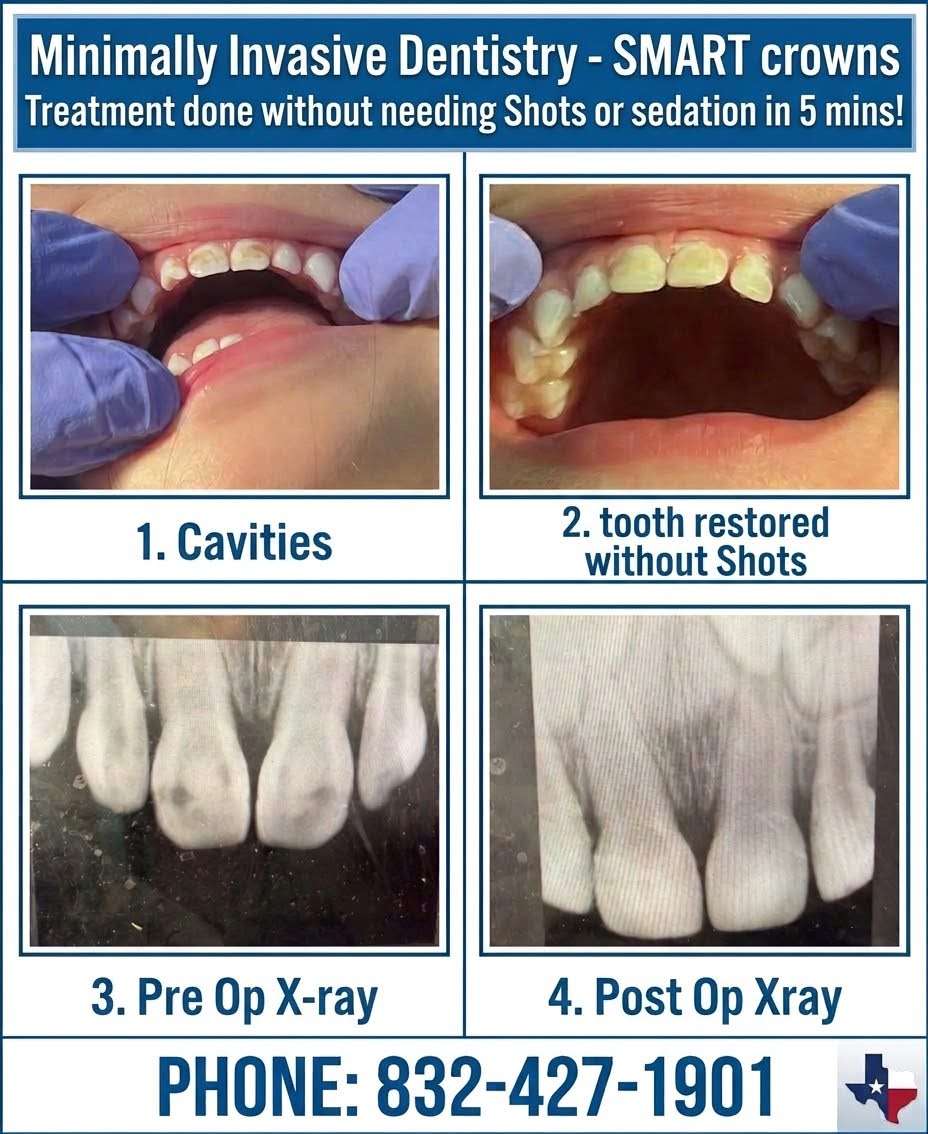
Minimally invasive pediatric dentistry matches treatment to the stage of dental disease while preserving as much healthy tooth structure as clinically appropriate. The pediatric dentist evaluates the affected tooth to determine whether it requires prevention, monitoring, disease arrest, conservative restoration, or more extensive treatment.
A minimally invasive restoration can preserve healthy tooth structure while treating selected areas of decay. The clinical example shown here documents affected teeth before treatment, restored teeth after treatment, and pre- and post-treatment radiographs. The appropriate treatment depends on decay extent, remaining tooth structure, pulp status, tooth type, and the child’s clinical needs.
Pediatric Fluoride Treatment supports early caries management by strengthening susceptible enamel and promoting remineralization when the tooth does not require restorative treatment.
Pediatric Dental Sealants protect susceptible pits and grooves by sealing chewing surfaces where plaque and food can accumulate. Sealants serve a preventive role rather than restoring teeth with extensive structural damage.
Other minimally invasive caries-management methods include silver diamine fluoride, interim therapeutic restorations, resin infiltration, and the Hall technique for selected clinical situations. The pediatric dentist selects a method according to the lesion, affected tooth, disease stage, and treatment needs rather than applying the same technique to every cavity.
A cavity that requires restoration can receive a Pediatric Dental Filling when sufficient tooth structure remains to support the restoration. Deeper decay, pulp involvement, infection, or extensive structural loss can require a different treatment because minimally invasive care does not replace necessary restorative or pulp treatment.
What Are the Benefits of Minimally Invasive Dentistry?
Minimally invasive dentistry preserves healthy tooth structure while treating dental disease at the appropriate stage.
Its main clinical goals are to:
- Preserve sound enamel and dentin.
- Detect disease before greater structural damage develops.
- Prevent or arrest selected areas of tooth decay.
- Remove less healthy tooth structure during restorative care.
- Preserve pulp vitality when clinically possible.
- Reduce unnecessary treatment without delaying necessary treatment.
Minimally invasive care can also reduce treatment complexity in selected cases because early disease requires a different intervention from advanced decay. Comfort remains case-specific; minimally invasive dentistry does not guarantee that a child will avoid drilling, local anesthesia, sedation, or restorative treatment.
How Does the Pediatric Dentist Choose Between Monitoring, Arresting, and Restoring Decay?
The pediatric dentist selects the least invasive treatment that can adequately control the disease and protect the tooth. “Conservative” does not mean choosing the smallest procedure regardless of the clinical findings.
An early non-cavitated lesion can qualify for remineralization and monitoring. Selected active caries can qualify for an arrest strategy. A cavitated lesion with sufficient remaining tooth structure can require restoration.
The decision changes as disease progresses. Extensive structural loss can require a pediatric dental crown because a crown surrounds more remaining tooth structure than a filling.
Decay involving the dental pulp requires another level of treatment. Pediatric Pulp Therapy treats selected teeth when pulp findings make preventive care or a simple restoration insufficient.
A tooth that cannot be predictably preserved can require extraction. The dentist evaluates the tooth type, infection, root status, structural condition, and role of the tooth before recommending removal.
The least aggressive-looking treatment is not always the most conservative treatment for the tooth. Delaying necessary treatment can allow disease to progress beyond the point where a smaller intervention remains appropriate.
When Is Another Treatment Better?
Another pediatric dental treatment is better when minimally invasive disease management cannot adequately treat structural damage, pulp involvement, infection, or other advanced findings.
A filling can restore selected cavities. A crown can protect a tooth with greater structural loss. Pulp therapy can treat an eligible tooth with pulp involvement. Extraction can become appropriate when the tooth cannot be restored predictably.
Prompt examination is necessary when a child develops dental pain, facial or gum swelling, signs of infection, significant tooth breakdown, or dental trauma
Caring for the Treated or Monitored Tooth
Follow-up care determines whether a minimally invasive treatment remains successful or the dental condition has changed. Monitoring is part of conservative disease management rather than an alternative to professional evaluation.
Parents should follow the brushing, fluoride, dietary, and follow-up instructions given after the examination. Schedule another evaluation sooner if the child develops pain, swelling, sensitivity, visible breakdown, or another change around the affected tooth.
Cavity risk can change as a child grows, so the dentist can adjust preventive and restorative care as new findings develop. The AAPD specifically identifies active surveillance and continued monitoring as components of minimally invasive caries management.
Why Choose Hospital Pediatric Dentist for Minimally Invasive Care?
Hospital Pediatric Dentist evaluates both tooth-level disease and child-level treatment needs before recommending care. The Houston, Texas pediatric dental practice evaluates infants, children, teenagers, and patients with special healthcare needs.
Treatment planning considers decay depth, pulp status, remaining tooth structure, tooth mobility, the number of affected teeth, and treatment complexity. The evaluation also considers age, medical and dental history, development, anxiety, behavior, cooperation, communication needs, and treatment tolerance.
These factors matter when a child cannot complete routine dental treatment safely or effectively in the office. Hospital Pediatric Dentistry becomes relevant for selected complex cases when treatment needs, behavior, medical factors, or safety requirements indicate evaluation for another care setting.
Hospital Pediatric Dentist is located at 17440 FM 529, Suite 102, Houston, TX 77095. Office hours are Monday through Saturday from 9:00 a.m. to 5:30 p.m. and Sunday is closed.
Schedule a Minimally Invasive Pediatric Dental Evaluation in Houston
A pediatric dental examination determines whether prevention, monitoring, disease arrest, conservative restoration, or another treatment is appropriate. Hospital Pediatric Dentist evaluates the tooth and the child before recommending treatment. Parents in Houston, Texas can request an evaluation or call 832-464-7172 to discuss the next step for their child.
Frequently Asked Questions
Q. Can a child’s cavity be treated without drilling?
Some cavities can be managed without conventional drilling, but the tooth requires examination first. Lesion depth, activity, enamel breakdown, remaining tooth structure, pulp status, and tooth type determine whether prevention, arrest, monitoring, or restoration is appropriate.
Q. Is minimally invasive dentistry comfortable for children?
Minimally invasive treatment can reduce intervention in appropriately selected cases. Comfort still depends on the dental condition, selected procedure, child’s age, anxiety, cooperation, and whether restorative treatment or local anesthesia is necessary.
Q. Is minimally invasive dentistry suitable for every child?
No single minimally invasive method is suitable for every child or tooth. The pediatric dentist evaluates the tooth condition, cavity risk, symptoms, medical history, development, behavior, cooperation, and treatment complexity before selecting care.
Q. Does minimally invasive dentistry work differently for baby teeth?
Primary and permanent teeth require different treatment decisions. The dentist considers tooth type, remaining structure, pulp status, disease activity, development, expected function, and the consequences of preserving or removing the affected tooth.
Q. Does minimally invasive care mean my child will never need a crown?
No. Minimally invasive dentistry does not replace necessary restorative care. Greater structural damage can require a crown, while pulp involvement, infection, or a non-restorable tooth can require pulp therapy or extraction instead.