
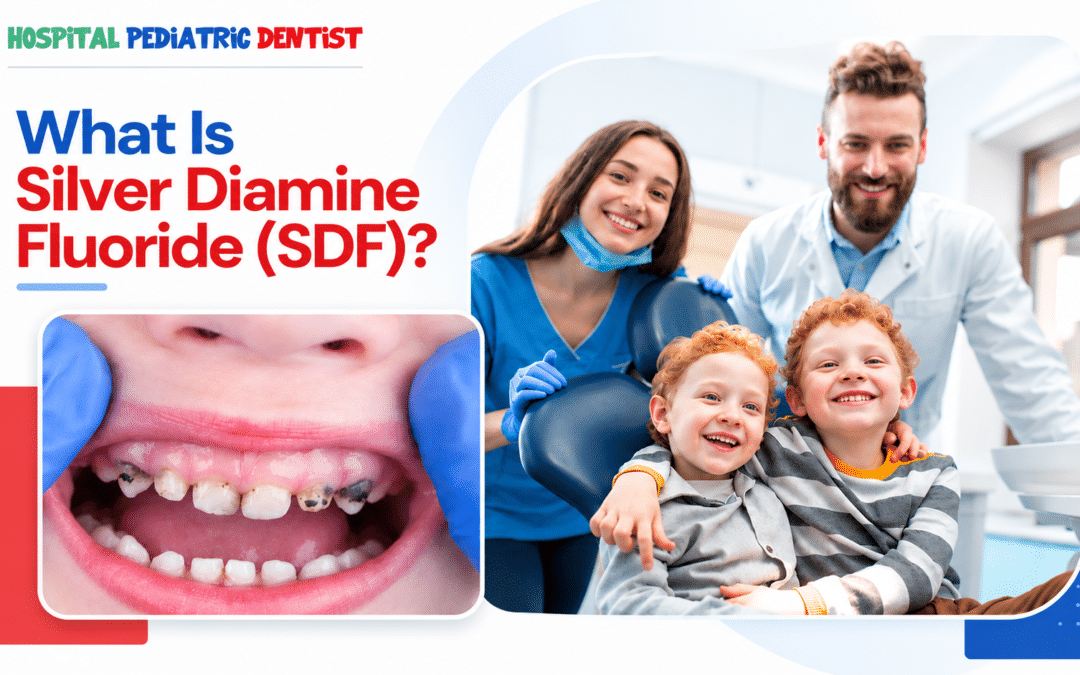
Silver diamine fluoride (SDF) is a topical dental material used to arrest or slow suitable areas of active tooth decay. A pediatric dentist applies SDF to the affected area of a tooth rather than removing decay and rebuilding the tooth with a traditional restoration.
SDF can be useful in a child’s cavity-management plan, but it is not appropriate for every cavity. The dentist must consider the depth and location of the decay, the condition of the tooth, symptoms, and the child’s individual treatment needs before recommending it.
Hospital Pediatric Dentist evaluates children in Houston to determine whether SDF, a filling, or another treatment is appropriate. Call 832-464-7172 to request a pediatric dental evaluation.
What Is Silver Diamine Fluoride?
Silver diamine fluoride is a topical material that can arrest active tooth decay without restoring the tooth structure already lost to the cavity. SDF contains silver and fluoride, which have different roles in managing decay.
Silver has antimicrobial properties that act against bacteria involved in the decay process. Fluoride supports remineralization and hardening of affected tooth structure.
The material is applied directly to the selected decayed area. This makes SDF different from a pediatric dental filling, which restores part of the tooth structure lost or damaged by decay.
The American Academy of Pediatric Dentistry supports SDF as part of an ongoing, individualized caries-management plan. The AAPD also describes SDF as a minimally invasive approach that may prevent or delay the need for more extensive procedures in appropriate cases.
How Does SDF Work on a Child’s Cavity?
SDF acts on the decayed area by controlling bacteria involved in tooth decay and supporting the hardening of affected tooth structure. These actions can arrest or slow the progression of a suitable cavity.
SDF manages active decay differently from a filling or crown. It acts on the disease process but does not rebuild the part of the tooth that has already been lost.
What Does the Silver in SDF Do?
Silver has antimicrobial activity against bacteria involved in tooth decay. This action is part of the process that allows SDF to control an active caries lesion.
The goal is caries arrest: stopping the active decay process from continuing to damage the tooth.
What Does the Fluoride in SDF Do?
Fluoride supports remineralization and hardening of affected tooth structure. This action complements the antimicrobial role of silver.
SDF can therefore arrest or slow suitable decay, but it cannot replace missing tooth structure. A child may still need restorative treatment if the tooth requires its shape, structure, or function to be restored.
Why Do Pediatric Dentists Use SDF for Children?
Pediatric dentists may consider SDF when controlling active tooth decay without immediately completing a traditional restoration is appropriate for the child and tooth.
There are 4 main reasons SDF may enter a pediatric cavity-management plan:
- Control active decay when the cavity is suitable for SDF.
- Reduce immediate treatment complexity when restorative treatment cannot be completed appropriately at that time.
- Manage a selected cavity while the tooth continues to be monitored.
- Create another treatment option when age, cooperation, anxiety, developmental needs, or medical factors affect treatment planning.
The AAPD supports SDF within individualized caries management rather than as a replacement for all restorative dentistry. Minimally invasive approaches still require monitoring for changes in the cavity, pain, and signs of infection.
Which Children May Be Considered for SDF?
SDF candidacy depends on the affected tooth and the individual child’s treatment needs. A child’s age alone does not determine whether SDF is appropriate.
A pediatric dentist may evaluate:
- the child’s age and development;
- the child’s ability to cooperate during treatment;
- dental anxiety and previous treatment behavior;
- sensory or communication needs;
- special healthcare needs;
- the number and location of affected teeth; and
- the ability to complete restorative treatment safely.
SDF is included in AAPD guidance for caries management in children and adolescents, including those with special healthcare needs. However, the treatment decision remains individualized.
For children whose developmental, behavioral, sensory, communication, or medical needs affect dental treatment, special needs pediatric dentistry may also be relevant to the overall care plan.
Which Cavities Can Be Treated With SDF?
A pediatric dentist must evaluate the cavity and affected tooth before determining whether SDF is appropriate. The presence of a cavity alone does not establish SDF candidacy.
Six factors can influence that decision:
| Factor | Why It Matters |
|---|---|
| Cavity depth | The extent of decay affects the available treatment options. |
| Tooth type | Treatment planning can differ between baby and permanent teeth. |
| Remaining tooth structure | Significant structural loss may require restorative treatment. |
| Symptoms | Pain or other symptoms can change the treatment pathway. |
| Signs of infection | Infection requires further evaluation rather than simply treating visible decay. |
| Tooth location | Front and back teeth can have different functional and appearance considerations. |
A pediatric dental exam allows the dentist to evaluate the tooth, the decay, symptoms, and other clinical factors before recommending treatment.
Why Does SDF Turn a Cavity Black?
SDF can permanently darken the decayed tooth structure it contacts. The treated area may become dark brown or black, which is an important appearance trade-off for parents to understand before choosing treatment.
The discoloration affects the decayed area rather than serving as a cosmetic treatment for the tooth. This difference matters because a visible dark area on a front tooth can create a different concern from darkened decay on a less-visible back tooth.
The AAPD identifies permanent black staining of carious tooth tissue as an important adverse effect that should be discussed as part of informed consent for SDF treatment.
Does the Black SDF Stain Go Away?
Dark staining of SDF-treated decayed tooth structure can remain visible. Parents should not expect the darkened cavity to behave like a temporary surface stain that simply washes away.
SDF that contacts surrounding soft tissues can produce a different type of discoloration. Parents should ask the treating dentist what appearance changes to expect for the specific tooth being considered.
Does Tooth Location Matter?
Tooth location can affect how important SDF staining is to a family’s treatment decision. A dark area on a front tooth is generally more visible than the same change on a back tooth.
The location of the tooth should therefore be considered alongside the condition of the cavity, remaining tooth structure, symptoms, and treatment alternatives.
Does SDF Permanently Fix a Cavity?
SDF can arrest suitable active decay, but it does not rebuild tooth structure that has already been lost.
Two concepts explain the difference:
- Caries arrest controls the active decay process.
- Restoration rebuilds or covers damaged tooth structure.
A tooth can therefore respond to SDF and still need continued monitoring. Some teeth may later require a filling, crown, or another treatment based on their clinical condition.
This distinction is important because SDF should not be described as a universal permanent replacement for restorative dental care. The AAPD specifically notes that minimally invasive approaches do not replace conventional restorations and require active monitoring.
SDF vs. Filling: How Does a Pediatric Dentist Decide?
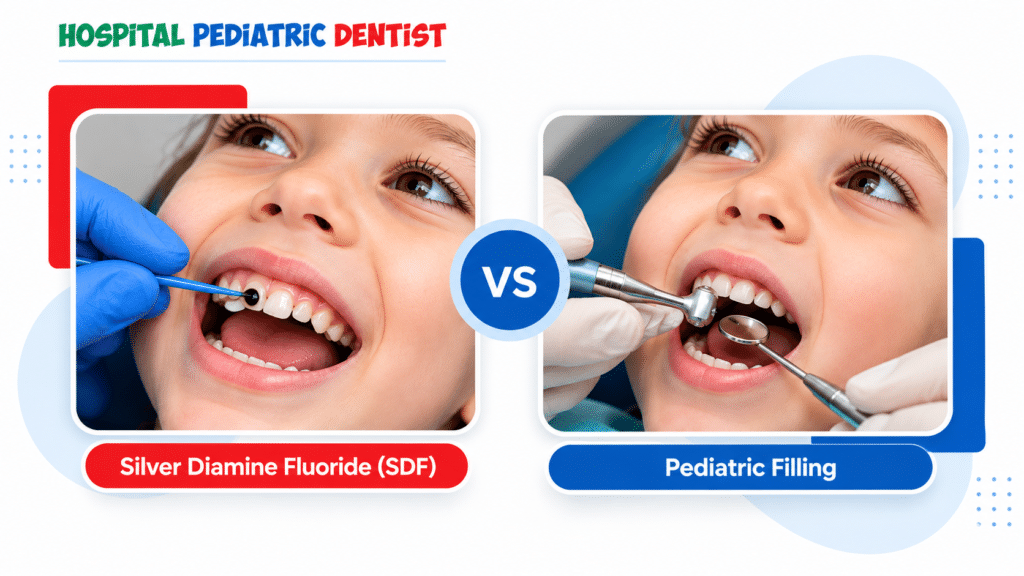 A pediatric dentist chooses between SDF and a filling by evaluating the cavity, tooth condition, symptoms, treatment goal, and the child’s ability to complete care. The treatments have different purposes.
| Decision Factor | SDF | Pediatric Filling |
|---|---|---|
| Primary purpose | Arrest or slow suitable active decay | Restore damaged tooth structure |
| Treatment approach | Topical application | Restorative procedure |
| Missing tooth structure | Does not rebuild it | Replaces part of the lost structure |
| Appearance | Treated decay can become dark | Restorative material rebuilds the treated area |
| Child factors | May be considered when cooperation affects treatment planning | Requires an appropriate approach for completing restorative care |
| Future care | Requires monitoring and may be followed by another treatment | Requires continued dental monitoring after restoration |
Neither treatment is automatically appropriate for every child or every cavity.
The decision follows a clinical path:
Cavity characteristics → tooth condition → symptoms → child factors → treatment goal → appropriate treatment
For parents comparing SDF with restorative treatment, the pediatric dental fillings page explains how fillings restore teeth affected by cavities.
When Might a Filling or Another Treatment Be Better Than SDF?
Another treatment may be appropriate when arresting decay alone does not address the condition of the tooth or the child’s clinical needs.
A pediatric dentist may consider another treatment when there is:
- significant loss of tooth structure;
- pain or other symptoms that require further evaluation;
- concern about infection;
- a need to restore tooth shape or function;
- an important cosmetic concern about dark staining; or
- a cavity whose clinical characteristics support another treatment.
A filling can restore lost tooth structure in some cases. A pediatric dental crown can cover and protect a tooth when more extensive restoration is appropriate.
SDF is one option within cavity management, not a required step before every filling or crown.
What Happens During SDF Treatment?
SDF treatment involves placing the material on a selected area of tooth decay after a dental professional determines that the tooth is appropriate for treatment.
From a parent’s perspective, the process generally follows 5 stages:
- Evaluate the tooth and determine whether SDF is appropriate.
- Prepare the treatment area for controlled application.
- Apply SDF to the selected decayed area.
- Monitor the tooth after treatment.
- Reassess the cavity during follow-up care.
The most important step is the first one. SDF should follow diagnosis and an individualized treatment plan rather than being selected simply because a child has a cavity. The AAPD states that SDF use requires professional diagnosis, a patient-specific plan, and continued monitoring.
What Happens After SDF Is Applied?
A tooth treated with SDF requires follow-up because the dentist must continue to evaluate the cavity and condition of the tooth.
Parents may notice that the treated decayed area becomes darker. The dentist then monitors whether the lesion remains arrested and checks for changes in symptoms or tooth structure.
Follow-up care can also include cavity-risk management, home oral hygiene, preventive care, reassessment, repeat SDF when clinically indicated, or future restorative treatment.
The pediatric fluoride treatment page explains the broader role of professionally applied fluoride in protecting children’s teeth. SDF has a different purpose because it can be used specifically as a caries-arresting treatment.
Can a Child Still Need a Filling or Crown After SDF?
A child can still need restorative treatment after SDF because SDF controls suitable decay but does not replace missing tooth structure.
There are 3 possible treatment pathways after SDF:
- Monitor the tooth when the lesion remains arrested and the tooth remains clinically acceptable.
- Restore the tooth later when a filling becomes appropriate.
- Select another treatment when changes in the tooth or symptoms require a different approach.
The correct pathway depends on follow-up findings. SDF treatment does not guarantee that a tooth will never need another procedure.
What Should Parents Ask Before Choosing SDF?
Parents should understand the treatment goal, expected staining, follow-up plan, and alternatives before making a decision about SDF.
Useful questions include:
- What part of my child’s tooth is affected?
- Is the affected tooth a baby tooth or permanent tooth?
- Why is SDF being considered for this cavity?
- What is SDF expected to accomplish for this tooth?
- How visible could the darkened area be?
- How will the cavity be monitored?
- Could my child need a filling or crown later?
- What other treatment options are appropriate for this tooth?
Clear answers to these questions allow parents and the pediatric dentist to make a treatment decision based on the child and tooth rather than on one benefit or drawback of SDF.
How Can Parents Reduce the Risk of More Cavities?
Cavity management should address future decay risk as well as a cavity already treated with SDF.
Parents can support their child’s prevention plan by:
- brushing with an age-appropriate amount of fluoride toothpaste;
- cleaning between teeth when appropriate;
- limiting frequent exposure to sugary foods and drinks;
- maintaining recommended pediatric dental examinations; and
- following the child’s individualized cavity-prevention plan.
SDF does not replace daily oral hygiene or preventive dental care. It addresses selected active decay within a broader caries-management plan.
Where Can Parents Ask About Silver Diamine Fluoride in Texas?
A pediatric dental evaluation can determine whether SDF or another cavity treatment is appropriate for a child’s tooth.
HPD evaluates children in Houston, Texas, based on the condition of the affected tooth, symptoms, developmental and behavioral factors, and the treatment needed to protect the tooth. An evaluation is especially important when a cavity is painful, structurally damaged, or difficult to treat through a routine approach.
Parents can schedule a pediatric dental evaluation with Hospital Pediatric Dentist at 17440 FM 529, Suite 102, Houston, TX 77095 to discuss their child’s cavity and appropriate treatment options.
Frequently Asked Questions About SDF for Children
Q. Is Silver Diamine Fluoride Safe for Children?
SDF is used for caries management in pediatric dentistry, including in children and adolescents, but its use should follow an individualized dental evaluation. The American Academy of Pediatric Dentistry supports SDF as part of an ongoing caries-management plan and has published clinical guidance for its use in pediatric patients.
Q. Does SDF Hurt?
SDF is applied topically to the selected tooth surface rather than through the mechanical tooth preparation used for a traditional filling. A child’s comfort and treatment experience can still depend on the tooth’s condition and individual needs.
Q. Can SDF Be Used on Baby Teeth?
SDF can be used to arrest suitable cavitated caries lesions in primary, or baby, teeth. AAPD clinical guidance supports 38 percent SDF for arresting cavitated lesions in primary teeth as part of a comprehensive caries-management program.
Q. Does SDF Turn the Whole Tooth Black?
SDF can permanently darken the decayed tooth structure it contacts. The appearance and extent of discoloration depend on the treated area, so parents should discuss the expected result with the dentist before treatment.
Q. Is SDF Better Than a Filling for a Child’s Cavity?
SDF and fillings serve different purposes, so one is not automatically appropriate for every cavity. SDF can arrest suitable active decay, while a filling restores damaged or missing tooth structure. The dentist considers the cavity, tooth, symptoms, child factors, and treatment goal when choosing an approach.
Q. Will My Child Need a Filling After SDF?
Some teeth treated with SDF may later require a filling, crown, or another treatment, while others may continue to be monitored. The next step depends on whether the decay remains arrested, the amount of remaining tooth structure, symptoms, and the dentist’s follow-up findings.