
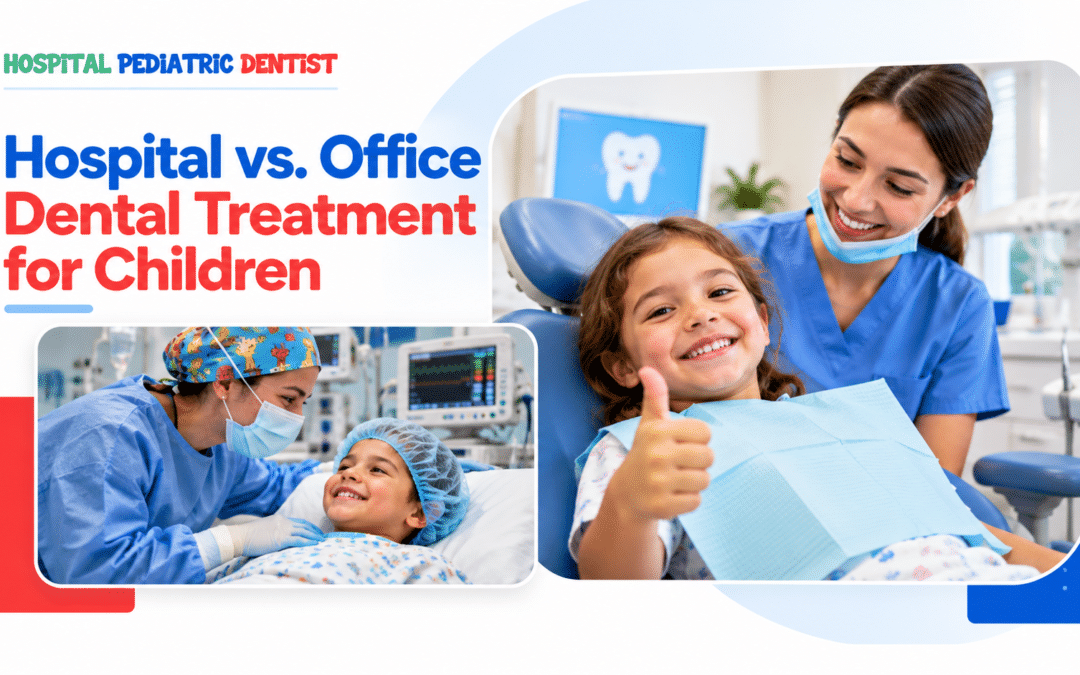
Hospital and office dental treatment for children differ in their care setting, available medical resources, and suitability for a child’s individual needs. A pediatric dental office manages routine examinations, preventive care, and many restorative procedures. Hospital-based dental care may be appropriate when medical conditions, complex treatment needs, or anesthesia requirements make office-based treatment unsuitable.
A pediatric dentist determines the appropriate setting by evaluating the child’s dental condition, medical history, development, cooperation, and treatment complexity. Neither setting is automatically necessary or preferable for every child.
What Is the Difference Between Hospital and Office Dental Treatment?
The primary difference is the treatment environment and the medical resources required to complete dental care appropriately. An office is designed for dental examination and treatment, while a hospital has additional medical facilities and personnel for patients requiring a higher level of support.
| Factor | Office Dental Treatment | Hospital Dental Treatment |
|---|---|---|
| Treatment location | Pediatric dental office | Hospital facility |
| Common procedures | Exams, cleanings, sealants, fillings, and selected restorative procedures | Selected complex restorative, surgical, or extensive dental procedures |
| Anesthesia | Local anesthesia, with sedation or general anesthesia in appropriately equipped facilities | Anesthesia services based on the child’s needs and the facility |
| Medical resources | Equipment, personnel, and monitoring appropriate to the services performed | Hospital medical resources and specialized support |
| Patient selection | Children whose needs can be managed appropriately in the office | Children whose circumstances require hospital-level resources |
| Recovery | Depends on the procedure and anesthesia | Monitored according to the procedure, anesthesia, and discharge criteria |
The setting does not determine the dental procedure by itself. A filling, crown, or extraction may be performed in either environment when the child’s condition and the facility’s capabilities make that setting appropriate.
When Does a Child Need Hospital Dental Treatment?
A child may need hospital dental treatment when necessary care cannot be completed appropriately in a dental office because of medical, behavioral, anesthesia-related, or treatment-complexity factors.
Extensive Dental Treatment Needs
Children with multiple cavities, severely damaged teeth, or dental infections may require several restorative or surgical procedures.
The pediatric dentist evaluates the number of affected teeth, the extent of damage, and whether treatment can be completed through office appointments. Extensive dental work does not automatically require a hospital.
Complex Medical Conditions
Children with certain heart conditions, respiratory disorders, seizure disorders, or other significant medical concerns may require additional assessment and coordination.
A diagnosis alone does not determine hospital eligibility. The child’s current health, planned procedure, anesthesia requirements, and available medical resources influence the decision.
Special Healthcare Needs
Children with developmental, behavioral, sensory, communication, or physical needs may require adaptations during dental treatment.
A pediatric dentist evaluates whether these needs can be accommodated through office-based care, behavior guidance, or other appropriate options before considering a hospital setting.
Difficulty Cooperating During Treatment
Children who cannot remain still during necessary dental procedures may require a different treatment approach.
The dentist considers the child’s developmental stage, prior dental experiences, anxiety, and response to behavior-guidance techniques. Difficulty cooperating during one appointment does not automatically establish a need for general anesthesia.
Anesthesia and Monitoring Requirements
A hospital may be appropriate when the child’s medical circumstances or anesthesia needs require resources unavailable in the planned office setting.
The dental and anesthesia teams assess these requirements before treatment.
When Is Office Dental Treatment Appropriate for Children?
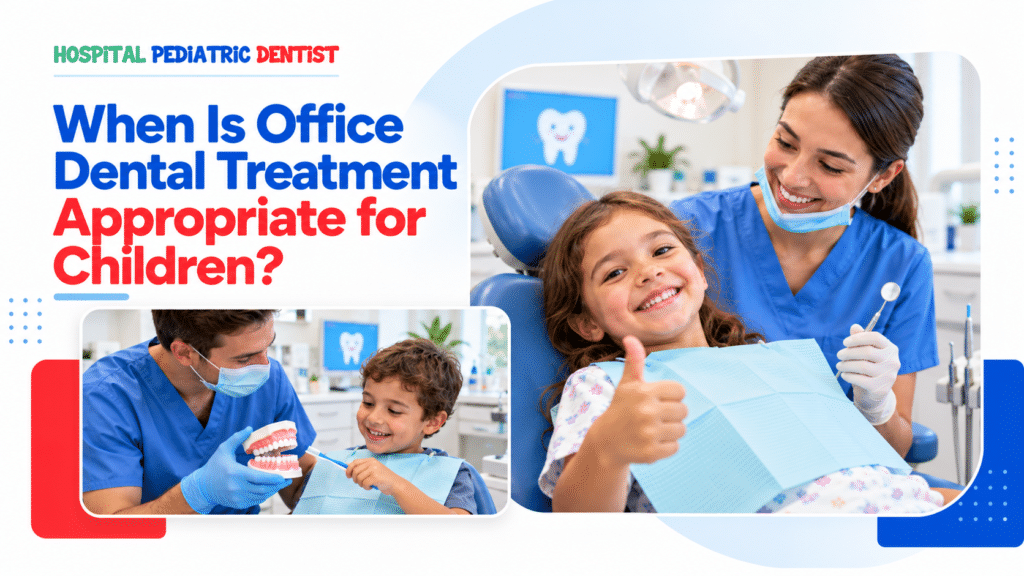
Office dental treatment is appropriate when the child’s dental needs can be managed with the available personnel, equipment, behavior guidance, and anesthesia resources.
Pediatric dental offices commonly perform examinations, cleanings, fluoride treatments, sealants, fillings, and selected crowns or extractions.
Office care may also remain appropriate for children with anxiety or special healthcare needs when individualized adaptations allow necessary treatment to be completed safely.
The dentist considers whether an office procedure can be completed without creating avoidable medical or behavioral risks.
Does a Child Need a Hospital for General Anesthesia?
General anesthesia does not always require a hospital. Appropriately equipped dental offices and other authorized facilities may perform selected pediatric dental procedures under general anesthesia with qualified anesthesia personnel.
The child’s health status, airway considerations, procedure complexity, anesthesia-team qualifications, and emergency-response capabilities affect where anesthesia can be administered.
General anesthesia and hospital dentistry are related but distinct concepts. General anesthesia describes the state of unconsciousness produced by medication. Hospital dentistry describes the setting where dental treatment occurs.
Parents should ask why a particular anesthesia method and location are recommended for their child.
Which Setting Is Safer for a Child’s Dental Treatment?
The appropriate setting is the one that can meet the child’s clinical and anesthesia requirements with suitable personnel, monitoring, equipment, and emergency resources.
Office-based care can be appropriate for routine and selected advanced procedures. Hospital-based care adds medical resources that may be necessary for children with complex health or treatment needs.
Both settings require safeguards appropriate to the procedures performed.
Before treatment, the team should assess relevant medical conditions, medications, anesthesia history, airway concerns, and procedural needs.
No dental or anesthesia setting eliminates every risk. Parents should receive an explanation of the expected benefits, possible complications, and reasonable alternatives.
How Does a Pediatric Dentist Choose Between Hospital and Office Care?
A pediatric dentist selects a treatment setting after evaluating both tooth-level findings and child-level factors.
| Evaluation factor | What the dentist considers |
|---|---|
| Dental condition | Decay, infection, fractures, and affected teeth |
| Treatment complexity | Procedures required and expected difficulty |
| Medical history | Diagnosed conditions, medications, and relevant health risks |
| Development and cooperation | Ability to tolerate the planned procedure |
| Behavioral needs | Anxiety, sensory sensitivities, and previous treatment experiences |
| Anesthesia requirements | Necessary level of anesthesia and appropriate monitoring |
| Facility capabilities | Available staff, equipment, and emergency resources |
The decision depends on how these factors interact.
For example, two children may both need several fillings. One may tolerate office treatment with local anesthesia and behavior guidance, while the other may require additional evaluation because of medical or cooperation-related concerns.
The number of cavities does not independently determine the treatment setting. Pediatric dentists assess a child’s medical history, developmental needs, behavior, and treatment requirements. The AAPD’s behavior guidance recommendations explain how these factors influence pediatric treatment planning.
What Should Parents Ask Before Choosing a Treatment Setting?
Parents should understand the reason for the recommendation before agreeing to a particular setting.
Useful questions include:
- Why is this treatment setting recommended for my child?
- Can the necessary dental procedures be completed in the office?
- What behavior-guidance or anesthesia alternatives are appropriate?
- Does my child’s medical history create additional precautions?
- Who will administer and monitor anesthesia, if required?
- What recovery and follow-up care should we expect?
The answers should relate to the child’s actual examination findings and care needs.
Pediatric Dental Treatment Evaluation in Houston, TX
Hospital Pediatric Dentist evaluates dental treatment needs for infants, children, teenagers, and patients with special healthcare needs in Houston.
The practice considers each child’s oral condition, medical history, development, behavior, cooperation, and treatment complexity when discussing potential care settings.
Parents can request a pediatric dental evaluation to determine whether routine office care, additional behavior guidance, sedation-related assessment, or hospital-based treatment may be appropriate.
Call 832-464-7172 or request a pediatric dental evaluation to discuss the appropriate treatment setting for your child.
Hospital vs. Office Dental Treatment: Frequently Asked Questions
Q. Can a toddler receive dental treatment in an office?
Yes. Toddlers can receive dental examinations and selected treatments in a pediatric dental office. The dentist considers the child’s development, cooperation, dental findings, and treatment requirements before recommending a procedure.
Q. Does having several cavities mean a child needs hospital dentistry?
No. Multiple cavities do not automatically require hospital treatment. The dentist evaluates cavity severity, the procedures needed, the child’s ability to tolerate treatment, and relevant medical factors.
Q. Do all children with autism need hospital dental treatment?
No. Autism alone does not determine the treatment setting. The dentist evaluates communication preferences, sensory needs, cooperation, medical history, and available adaptations before recommending office or hospital care.
Q. Is general anesthesia always required for hospital dentistry?
No. The anesthesia plan depends on the procedure, the child’s condition, and the treatment environment. Many planned pediatric hospital dental procedures use general anesthesia, but hospital care and general anesthesia are not interchangeable terms.
Q. Can a child return to regular dental visits after hospital treatment?
Yes. Children may return to office-based examinations and preventive visits after hospital treatment when their individual circumstances permit. Future care plans depend on ongoing dental findings and patient needs.