
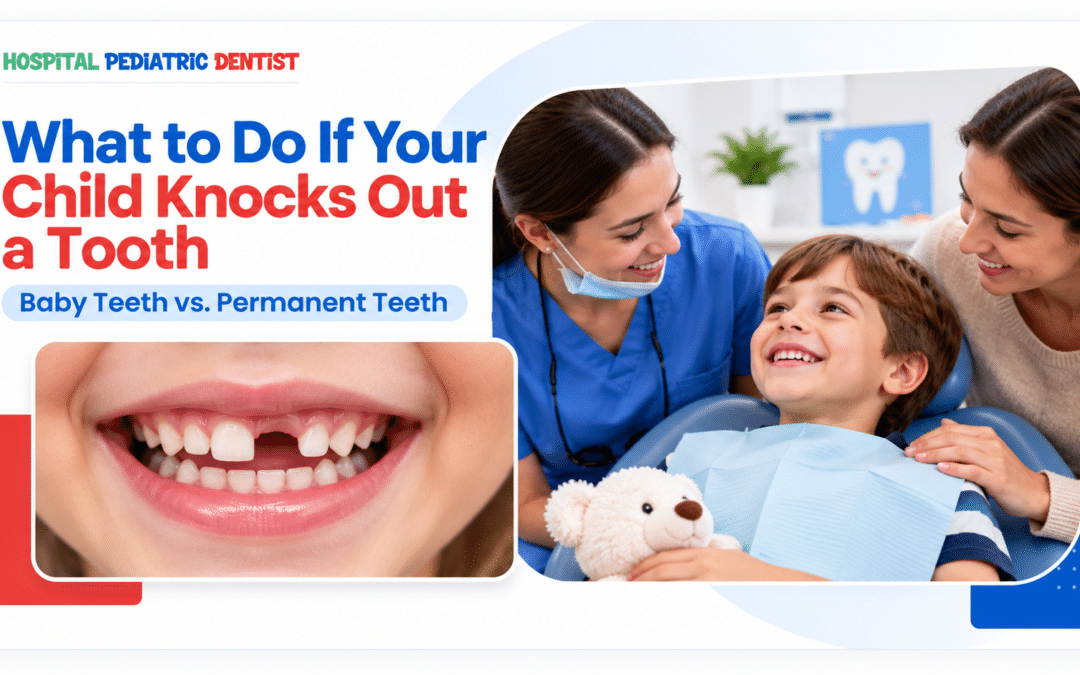
If your child knocks out a tooth, check for serious injuries, control the bleeding, and find out whether the missing tooth is a baby tooth or a permanent tooth. Never put a knocked-out baby tooth back into the gums. A permanent tooth, however, may be saved with quick action and emergency dental treatment.
A tooth that comes completely out of its socket after an injury is called a knocked-out tooth or dental avulsion. Falls, playground accidents, and sports injuries can cause this type of dental injury.
The next steps depend on the type of tooth your child has lost.
What Should You Do First If Your Child Knocks Out a Tooth?
Check your child for other injuries, stop the bleeding, and identify the missing tooth before taking further action. A knocked-out tooth needs prompt attention, but your child’s overall safety comes first.
Follow these steps:
- Check for serious injuries. Look for difficulty breathing, loss of consciousness, repeated vomiting after a fall, or signs of a serious head or facial injury. Seek emergency medical care immediately if these occur.
- Control the bleeding. Place clean gauze or a soft cloth over the injured area and apply steady, gentle pressure. A cold compress against the outside of the cheek can reduce swelling.
- Find the missing tooth. Look around the place where the injury happened. Pick up a recovered tooth by its crown, which is the visible white part, rather than its root.
- Identify the tooth type. Baby teeth and permanent teeth require different first-aid steps. Do not try to put the tooth back until you know which type it is.
- Contact a dentist promptly. A pediatric dentist can assess the injury and determine whether the tooth, gums, or surrounding structures need treatment.
Do not delay emergency medical care while searching for the tooth if your child has signs of a serious injury.
How Can You Tell If the Knocked-Out Tooth Is a Baby Tooth or a Permanent Tooth?
The tooth’s position, size, and your child’s stage of dental development can help identify whether it is a baby tooth or a permanent tooth. However, appearance and age alone may not give a reliable answer.
Baby teeth, also called primary teeth, are the first teeth children develop. Permanent teeth gradually replace them as children grow.
A child who has started losing baby teeth may have both types in their mouth at the same time.
| Baby Tooth | Permanent Tooth |
|---|---|
| Part of the child’s first set of teeth | Part of the second set of teeth |
| Usually smaller than its permanent replacement | Often larger than the baby tooth it replaces |
| Falls out naturally as permanent teeth develop | Intended to remain throughout adult life |
| Must not be replanted after being knocked out | May be replanted after an injury when appropriate |
What If You Are Not Sure Which Tooth Your Child Lost?
Do not try to reinsert a knocked-out tooth when you cannot tell whether it is a baby tooth or a permanent tooth.
Place the tooth in a container of milk and seek immediate dental advice. A pediatric dentist can identify the tooth and examine the injured area.
This distinction matters because putting a baby tooth back into its socket can damage the permanent tooth developing underneath it.
What Should You Do If Your Child Knocks Out a Baby Tooth?
Do not put a knocked-out baby tooth back into the socket. Control the bleeding, protect the injured gums, and arrange a pediatric dental examination.
Baby teeth eventually fall out naturally, but losing one because of an accident is different from normal tooth loss. The injury may also affect nearby teeth, gums, or the developing permanent tooth.
Why Shouldn’t You Put a Knocked-Out Baby Tooth Back In?
A knocked-out baby tooth should not be replanted because its root sits close to the developing permanent tooth.
Pushing the baby tooth back into the socket can injure the permanent tooth or interfere with its later development.
Replantation also creates unnecessary treatment and safety risks for a young child. The pediatric dentist will instead examine the area and decide whether monitoring or another treatment is needed.
How Do You Care for the Gums After a Baby Tooth Is Knocked Out?
Protect the injured gums with gentle pressure and avoid further irritation until your child receives dental advice.
Parents can:
- Apply clean gauze to control bleeding.
- Place a cold compress against the outside of the cheek.
- Keep fingers and objects away from the empty socket.
- Avoid giving the child hard or crunchy foods while the area is sore.
- Contact a pediatric dentist to assess the injury.
Do not attempt to push anything into the empty socket.
A dentist may recommend an examination and dental X-rays if there is concern about a broken root, an injured neighboring tooth, or a tooth pushed into the gums.
What Should You Do If Your Child Knocks Out a Permanent Tooth?
A knocked-out permanent tooth needs immediate dental care because quick replantation may preserve the tooth.
The goal is to protect the delicate cells on the root, prevent the tooth from drying out, and get professional treatment without delay.
How Should You Pick Up and Clean a Knocked-Out Permanent Tooth?
Pick up the tooth by its crown and avoid touching or scrubbing the root.
The root is covered by delicate cells that connect the tooth to the surrounding bone. These cells are part of the periodontal ligament, which holds a tooth in place.
Touching, scrubbing, or allowing the root to dry can damage those cells.
Follow these steps:
- Find the knocked-out permanent tooth.
- Hold it by the crown rather than the root.
- Gently rinse visible dirt away with milk or saline solution.
- Do not scrub the tooth or use soap, disinfectant, or toothpaste.
Handle the tooth as little as possible.
Can You Put a Knocked-Out Permanent Tooth Back In?
A confirmed permanent tooth can sometimes be placed back into its socket immediately after an injury. This is called replantation.
Replantation should only be attempted when your child is alert, able to cooperate, and can safely keep the tooth in place.
Gently position the tooth in its original socket without forcing it. Ask your child to bite softly on clean gauze to hold the tooth in place.
Seek emergency dental care immediately, even if the tooth appears to be back in position.
Do not attempt replantation when the tooth type is uncertain, your child cannot cooperate safely, or the tooth does not fit into place easily.
How Should You Store a Knocked-Out Tooth If You Cannot Put It Back?
Keep a knocked-out permanent tooth moist while traveling to an emergency dentist.
Suitable storage options include:
- Milk: A commonly recommended option that protects the root cells better than allowing the tooth to dry.
- Tooth-preservation solution: A dental emergency storage product designed for knocked-out teeth.
- Saline solution: An alternative when a tooth-preservation solution or milk is unavailable.
- Saliva: Your child can spit into a clean container, if old enough to do so safely.
Do not wrap the tooth in a dry tissue or leave it exposed to air. Avoid storing it in tap water.
Never place a loose tooth inside a young child’s cheek or mouth for transport because it could become a choking hazard.
Bring the tooth with your child for immediate dental treatment.
How Long Can a Knocked-Out Permanent Tooth Be Saved?
A knocked-out permanent tooth has the best chance of being saved when it is replanted within the first few minutes after the injury.
The American Academy of Pediatrics states in its first aid instructions for a knocked-out permanent tooth that replantation within about 15 minutes gives the tooth its best chance of survival.
The longer a tooth remains dry outside the mouth, the more damage can occur to the cells covering its root.
However, the passage of time does not automatically mean the tooth cannot receive treatment.
A permanent tooth that has been outside the mouth for more than an hour still requires emergency dental evaluation. The dentist will assess its condition, how it was stored, and whether replantation remains appropriate.
Do not wait to see whether the pain or bleeding stops before seeking emergency care for a knocked-out permanent tooth.
What If Your Child’s Tooth Is Missing but You Cannot Find It?
A tooth that appears to be missing after an injury may have been knocked out, pushed into the gums, swallowed, or, less commonly, inhaled.
A pediatric dental examination is necessary to determine what happened.
Can a Tooth Be Pushed Into the Gums Instead of Knocked Out?
Yes. A strong impact can push a tooth deeper into its socket, making it look as though the tooth has disappeared.
Dentists call this injury tooth intrusion.
Parents may notice an empty-looking space, bleeding, swelling, or a tooth that appears much shorter than before.
Do not attempt to pull the tooth out or move it back into position yourself.
An intruded tooth requires prompt dental evaluation because its treatment differs from that of a tooth completely knocked out of the mouth.
How Does a Dentist Find a Missing Tooth After an Injury?
A pediatric dentist examines the gums, tooth socket, and nearby teeth to determine whether the missing tooth remains inside the surrounding tissues.
Dental X-rays may be needed to identify its position or check for hidden damage.
Tell the dentist if the tooth cannot be found. A child with coughing, wheezing, or breathing problems after a missing-tooth injury needs immediate medical assessment because inhalation of the tooth must be considered.
When Should You Take Your Child to the Emergency Room for a Tooth Injury?
Take your child to an emergency room when a dental injury occurs with signs of a serious head, facial, or breathing problem.
Seek emergency medical care for:
- Difficulty breathing or swallowing.
- Loss of consciousness.
- Repeated vomiting or unusual behavior after a head injury.
- Heavy bleeding that does not stop with steady pressure.
- Severe facial swelling or a suspected jaw fracture.
- A suspected inhaled tooth or tooth fragment.
A knocked-out permanent tooth is also a time-sensitive dental emergency.
For an isolated tooth injury without serious medical symptoms, contact a pediatric dentist immediately. An emergency pediatric dental evaluation in Houston can identify the injury and determine whether the tooth needs stabilization, restoration, or another treatment.
If urgent dental care is unavailable, go to an emergency department. Families in Houston can contact Hospital Pediatric Dentist for guidance about arranging an evaluation. Emergency appointment availability should be confirmed with the office before traveling.
What Will the Pediatric Dentist Check After a Tooth Is Knocked Out?
A pediatric dentist examines the injured tooth socket, nearby teeth, gums, and surrounding tissues before deciding what treatment is appropriate.
At Hospital Pediatric Dentist, an injury evaluation starts with understanding how the accident happened and whether the child lost a baby tooth or a permanent tooth.
The examination may include:
- Tooth identification: Confirming whether the injured tooth is primary or permanent.
- Gum and socket examination: Checking for cuts, swelling, bleeding, or damaged tissues.
- Nearby tooth examination: Looking for loose, chipped, fractured, or displaced teeth.
- Dental imaging: Taking X-rays when needed to assess hidden injuries.
- Treatment planning: Determining whether the child needs monitoring, tooth stabilization, or additional care.
A pediatric dental examination may also assess how an injury affects surrounding teeth and developing permanent teeth. Dental X-rays are selected when the findings require a closer look at the tooth roots, socket, or nearby structures.
A replanted permanent tooth may need a temporary splint to hold it in position while the surrounding tissues heal.
The dentist will also determine whether the tooth needs further treatment or follow-up to monitor its root and inner tissues.
Not every knocked-out tooth can be saved. The outcome depends on the injury, tooth type, storage conditions, and time before treatment.
Will a Permanent Tooth Grow After a Baby Tooth Is Knocked Out Early?
A permanent tooth usually erupts later after a baby tooth is lost early, but a serious injury can sometimes affect its development.
A knocked-out baby tooth does not grow back. The permanent replacement develops within the jaw and normally appears when the child reaches the appropriate stage of dental development.
However, an injury involving a baby tooth can sometimes affect the permanent tooth underneath it. Possible changes include delayed eruption, discoloration, altered tooth shape, or other developmental problems. These complications do not occur in every child. A pediatric dentist may recommend follow-up examinations to monitor the area.
Does a Child Need a Space Maintainer After Losing a Baby Tooth?
A space maintainer is not automatically needed when a baby tooth is knocked out.
Space maintainers are dental appliances that preserve room for a permanent tooth when early loss of another tooth may cause neighboring teeth to shift.
Losing a front baby tooth usually does not require a space maintainer. Losing a baby molar may require a different decision because nearby teeth can move into the empty space.
A space maintainer for kids may be recommended when a missing baby tooth creates a risk of losing the space needed for its permanent replacement. The dentist considers which tooth was lost, the child’s dental development, and the position of nearby teeth before selecting an appliance.
How Should You Care for Your Child’s Mouth After a Tooth Injury?
Follow the pediatric dentist’s instructions, protect the injured area, and attend recommended follow-up visits.
Care after a knocked-out tooth depends on whether the child lost a baby tooth or received treatment for a permanent tooth.
Parents can follow these general precautions:
- Choose soft foods. Avoid foods that place pressure on the injured area while it is healing.
- Keep the mouth clean. Follow the dentist’s instructions for gentle brushing and cleaning around the injury.
- Prevent another impact. Avoid activities that could injure the same area again during recovery.
- Monitor the gums. Contact the dentist if swelling, pain, bleeding, or other concerning symptoms develop or worsen.
- Attend follow-up visits. The dentist may need to monitor healing, tooth stability, or the development of permanent teeth.
A replanted permanent tooth can require continued monitoring even after it becomes stable.
Frequently Asked Questions
Q. My 2-Year-Old Knocked Out a Front Tooth. What Should I Do?
A two-year-old’s front tooth is normally a baby tooth. Do not put it back into the gums. Control bleeding with clean gauze and contact a pediatric dentist promptly to check for hidden injuries.
Q. Should I Bring the Knocked-Out Baby Tooth to the Dentist?
Bring the baby tooth if you can find it safely, but do not try to replant it. The dentist may examine the tooth and injured socket. Do not delay your child’s evaluation while searching for it.
Q. Can Losing a Front Baby Tooth Affect Eating or Speaking?
Losing a front baby tooth can temporarily change how a child bites certain foods or pronounces some sounds. The effect varies. A pediatric dentist can assess ongoing difficulties and determine whether additional evaluation is needed.
Q. What If Another Tooth Becomes Loose or Changes Color After the Injury?
A loose or discolored tooth may have experienced damage during the same accident. Contact a pediatric dentist for an examination. A color change does not always mean the tooth needs removal, but it should be evaluated.
Q. Will My Child Need a Fake Tooth After Losing a Baby Front Tooth?
Most children do not automatically need a replacement for a missing baby front tooth. A dentist may consider an appliance when there are specific functional or developmental concerns. The decision depends on the child’s individual needs.
What If My Child Knocks Out a Tooth at Night or When the Dental Office Is Closed?
Seek immediate emergency care for a knocked-out permanent tooth. Keep it moist if safe replantation is not possible. For a baby tooth, control bleeding and obtain prompt dental advice. Serious medical symptoms require emergency medical care.
Request a Pediatric Dental Evaluation in Houston
A knocked-out tooth requires the right next step for the child’s tooth type and injury.
Hospital Pediatric Dentist evaluates dental injuries in infants, children, teenagers, and patients with special healthcare needs in Houston, TX. A pediatric dental examination determines whether the child needs monitoring, treatment, or referral for a more complex injury.
Contact HPD or call 832-464-7172 to request an evaluation and confirm appointment availability.
This article is intended for parent education and does not replace a dental examination or emergency medical care.